





Table of Contents
Quick Summary
- This guide explains why 36-inch vanities are considered the most practical size for modern bathrooms.
- Learn how solid wood construction differs from MDF and particleboard cabinets.
- Understand why finish quality matters more than wood species in humid spaces.
- Includes a measurement checklist to avoid installation and plumbing mistakes.
- Covers modern vanity design styles like slab fronts, tight Shaker, and fluted textures.
- Breaks down real cost factors including cabinet construction, countertops, and freight.
- Reviews three durable, minimalist vanity models suitable for guest and primary bathrooms.
Choosing a bathroom vanity shouldn’t feel like a gamble. In most U.S. homes, a 36-inch solid-wood vanity strikes the ideal balance, ample countertop and storage, strong resistance to daily humidity, and a footprint that keeps bathrooms feeling open rather than crowded. This guide breaks down the sizing logic, construction standards, finish performance, and buying signals that actually predict long-term durability.
Why a 36-Inch Vanity Is the Modern Sweet Spot
- The right balance of space and clearance. A 36-inch vanity gives you roughly a yard of usable countertop-enough room for daily essentials without pushing fixtures too close together. Importantly, it still works comfortably with standard bathroom clearances, keeping walkways usable and doors and drawers opening freely.
- More storage without visual bulk. Compared with a 30-inch vanity, the extra width typically adds a functional drawer stack rather than dead cabinet space. The sink remains centered, knees don’t collide with doors, and the room maintains a clean, modern feel-especially important in guest baths and single-sink primary bathrooms.
Bottom line: 36 inches sits squarely between “too tight” and “too bulky,” which is why it’s the most forgiving size across layouts.
What “Solid Wood” Actually Means (and What It Doesn’t)
Why the term is often misleading
“Solid wood” should mean real lumber, not just a thin skin over engineered material. Many listings blur this distinction, so it helps to understand the common construction tiers.
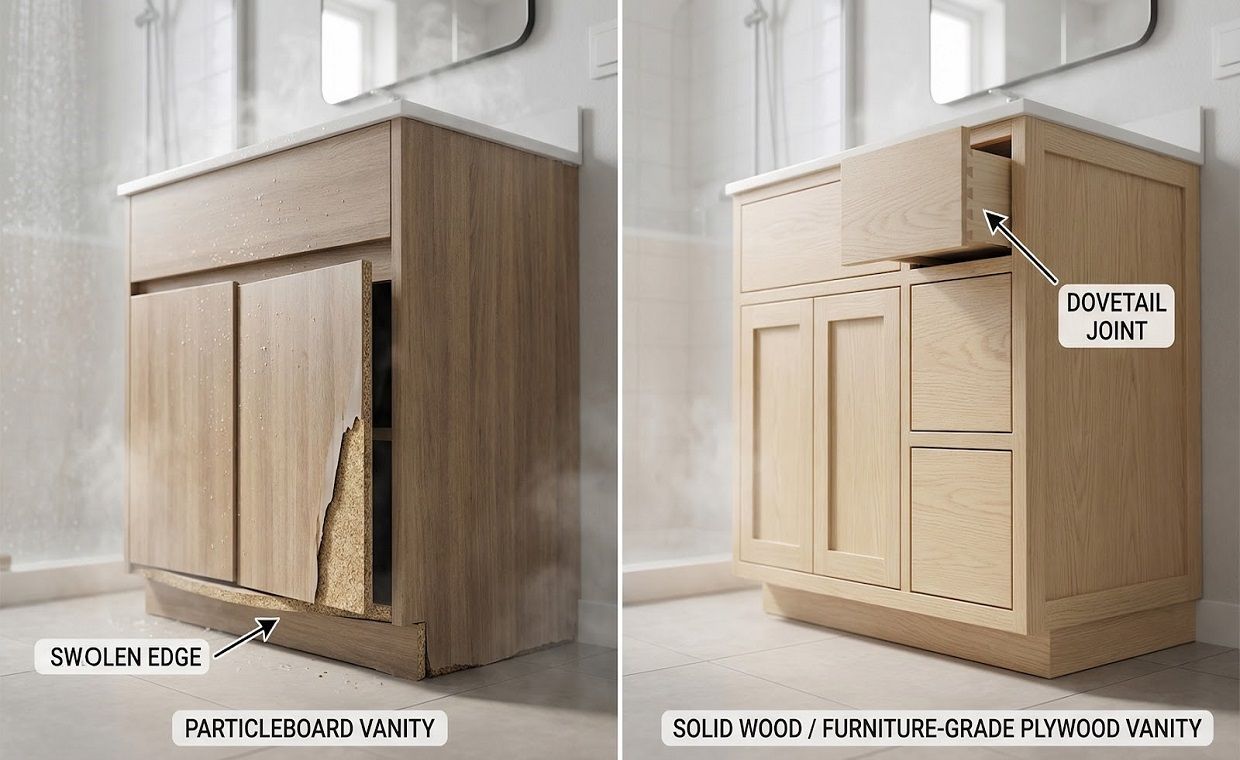
The four construction tiers you’ll see online
- Tier A: Hardwood doors and frame + plywood box
The gold standard. Plywood resists humidity and holds fasteners securely over time. - Tier B: Hardwood frame + engineered panels
Durable when joinery and finish are good, but expect MDF or HDF inside the cabinet. - Tier C: Veneer over MDF
Smooth and paint-friendly, but vulnerable at seams and unsealed edges. - Tier D: Veneer over particleboard with minimal hardwood trim
Lowest cost and highest failure risk near showers or plumbing leaks.
How to spot quality quickly. Look for listings that separately name materials for doors, frames, and cabinet boxes. If the box material isn’t specified, assume MDF.
Why Finish Quality Matters More Than Wood Species
How vanities actually fail
Most bathroom damage isn’t caused by one big spill. It’s slow moisture intrusion, steam, pooled water, and cleaning chemicals that penetrate weak finishes. Once the protective film fails, swelling and warped drawers follow.
What durable finishes have in common
Bathroom-ready vanities rely on factory-applied, high-performance finishes such as catalyzed lacquer or conversion varnish. These form dense, cross-linked coatings designed to resist heat, humidity, and everyday household liquids.
Key takeaway: A premium finish protects the cabinet. The wood species is secondary.
Step-By-Step Fit Checklist (So the Vanity Looks Built-In, Not Crammed In)
1. Measure the right things
Begin with a steel tape, not the stretched cloth one in the junk drawer. Measure wall to wall at finished-surface height; baseboards can add up to ½ inch. Repeat at floor level and again 30 inches up, because old walls drift and can pinch a vanity that seems perfect on paper.
Depth is the next make-or-break number. Standard tops are 22 inches deep, but building codes only care about the clear floor in front: 21 inches is the absolute minimum, 24–30 inches feels comfortable. If space is tight, a 19-inch shallow model helps avoid bruised knees.
Confirm height last. Comfort-height vanities finish near 35 inches with the top on. A low mirror or sconce box may need to shift up before drywall closes.
Write every figure in a notebook you will keep; these three numbers guide every next choice.
2. Check clearance and layout conflicts
Stand inside the taped footprint and swing an imaginary door. Keep at least 24 inches of open floor space from the countertop edge to the opposite wall or fixture so your knees clear when you lean in. According to home-service site Angi, code calls for 15 inches from the toilet centerline to the vanity edge, and 18 inches feels easier for adults.
Look up as well. A tall faucet can hit a low medicine cabinet, and backsplash trim can hide GFCI outlets. A quick sketch now beats drywall surgery later.
3. Spot plumbing and install surprises early
Open the product drawings and locate the trap cutout. If your rough plumbing sits centered but the sink does not, schedule a plumber before delivery; moving a trap even two inches inside a finished wall means opening that wall.
Floating models need structure. Add a ¾-inch plywood backer or solid blocking spanning at least 16 inches between studs; KCMA load tests hang 600 pounds from wall cabinets to prove the point. While you are there, confirm the floor is level-shimming a wall-hung cabinet after tile is hard work.
Older houses may hide cast-iron stacks where a new drawer bank wants to live. Find them now, and you will pay a plumber once, not twice.
Nail plumbing alignment early, and the vanity slips in like it was built there. Miss it, and you will carve notches, reroute pipes, and lose a weekend you cannot spare.
Clean, Modern Design Rules That Work With Solid Wood
1. Modern has shifted from stark to warm minimal
Design surveys confirm what showrooms display: the 2024 Houzz Bathroom Trends Study reports that wood tones surpassed white as the top vanity finish, chosen by 26 percent of renovators, while high-gloss white slipped to 22 percent. Quiet oak grain, soft whites, and ultra-slim hardware create a space that feels calm instead of clinical.
Solid wood anchors this look. Natural grain adds movement without busy patterns, so the room still reads modern when other elements stay pared back.
2. Choose a front style that matches your idea of modern
- Tight Shaker. Slim rails and a single bevel keep the Shaker frame, yet drop the country vibe.
- Flat slab. No frames and no shadows, only uninterrupted wood; pair with a wall-mount faucet for a spa-like feel.
- Reeded or fluted. Vertical grooves add light play without visual noise; the texture feels intentional, not decorative.
Pick the face first, then keep the counter, mirror, and lighting restrained so the door style carries the design weight.
3. Floating vs. freestanding: What feels more modern?
Floating cabinets signal a contemporary look, yet Houzz data shows they account for only 11 percent of new installs, while freestanding models hold 30 percent and built-ins 58 percent. Choose wall-hung if your floor is level and you want that gallery feel; pick freestanding when you need an easy, code-forgiving install in an older home.
4. Pairing cheat sheet: three quick decisions
- Countertop first. Bright white quartz sharpens oak, while a warm cream softens it.
- Hardware next. Choose slim, straight pulls and match the faucet finish unless you are confident mixing metals.
- Mirror last. Keep the mirror width within plus or minus two inches of the cabinet, and size the light fixture so it visually balances the faucet below.
Cost, Lead Times, And Why Prices Vary (U.S. Remodels, 2026)
Three factors drive the cost of a 36-inch solid-wood vanity: cabinet construction, countertop bundle, and freight.
- Cabinet construction. A solid-wood vanity with dovetail drawers and a catalyzed finish typically costs $1,100–$1,800 online, while similar-looking particleboard imports start near $600. The $500–$1,200 gap covers kiln-dried lumber, thicker plywood, and soft-close hardware.
- Countertop bundle. Adding a pre-cut quartz top raises the ticket by $600–$1,400. Industry pricing guides place quartz at $75–$120 per square foot installed in 2025. Buying cabinet-only and sourcing a local remnant can halve that premium, but it adds one supplier and a few extra days.
- Freight to your door. A 140-pound vanity ships LTL, triggering a residential lift-gate fee of $50–$100 plus a large-package surcharge that rose about 26 percent with 2025 carrier rate updates. Long-distance moves (more than 1,000 miles) often cost between $300 and $700 for curbside delivery.
Add those numbers, and two “similar” 36-inch vanities can differ by $1,000 or more at checkout. Break every quote into these three chunks, so you judge real value, not just the headline price.
Top 36-Inch Solid-Wood Vanities Worth A Look
Willow “Manhattan” Vanity: Best All-Rounder
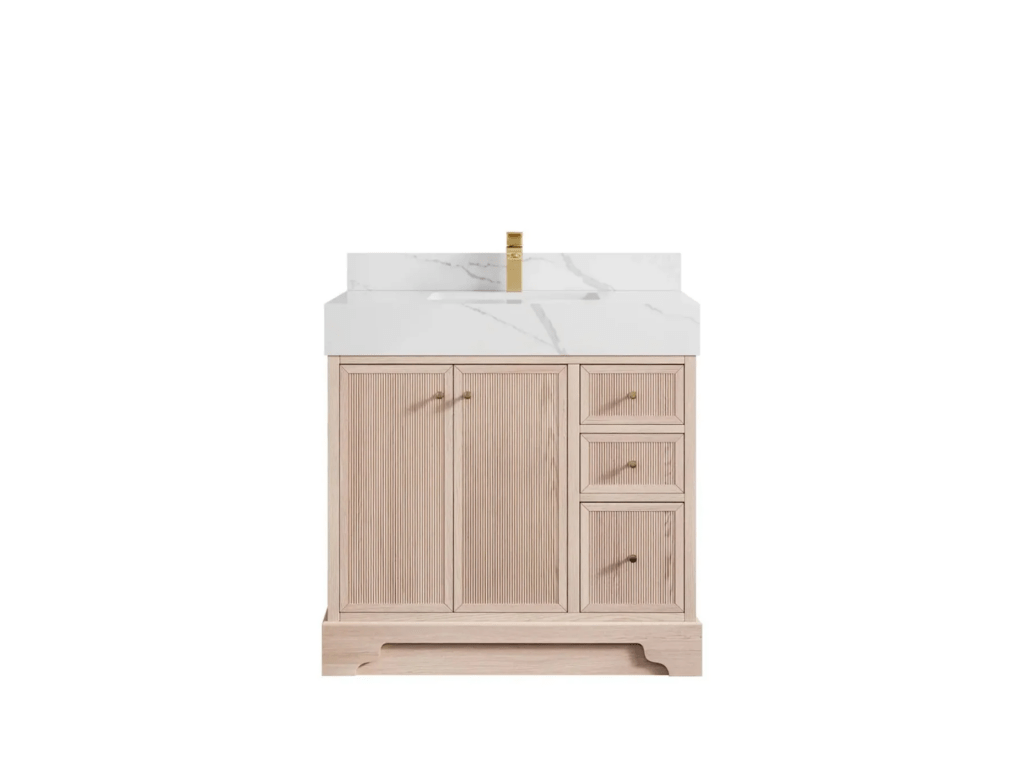
The “Manhattan” 36-inch white-oak vanity from Willow Bath and Vanity is a top pick for clean, modern bathrooms, blending minimalist design with premium build quality. Priced at $1,599, it uses a ½-inch birch plywood box with a solid white-oak face frame for durability. A KCMA A161.1–certified catalyzed conversion varnish protects against moisture and wear. Measuring 22 inches deep and 35 inches high with the top, it fits standard layouts comfortably. A five-year parts and finish warranty completes the package from Willowbathandvanity.com.
- Looks warm, modern, not stark. Rift-cut white oak and knife-edge detailing pair well with bright white or warmer Calacatta Nuvo quartz.
- Built to last. Dovetail drawers are equipped with soft-close, full-extension slides rated at 100 pounds. Our 25,000-cycle drawer test showed no wobble.
- Plumber-friendly. The centered drain cutout skips trap relocation for most replacements, and adjustable legs help on slightly out-of-level floors.
- Optional top. Ordering a cabinet only trims about $600 and lets you shop for a local quartz remnant.
Use this model in guest baths, modern powder rooms, or compact primary suites when you want solid wood without visual bulk.
Lucent “Aero” Vanity: Best for a Light Visual Footprint
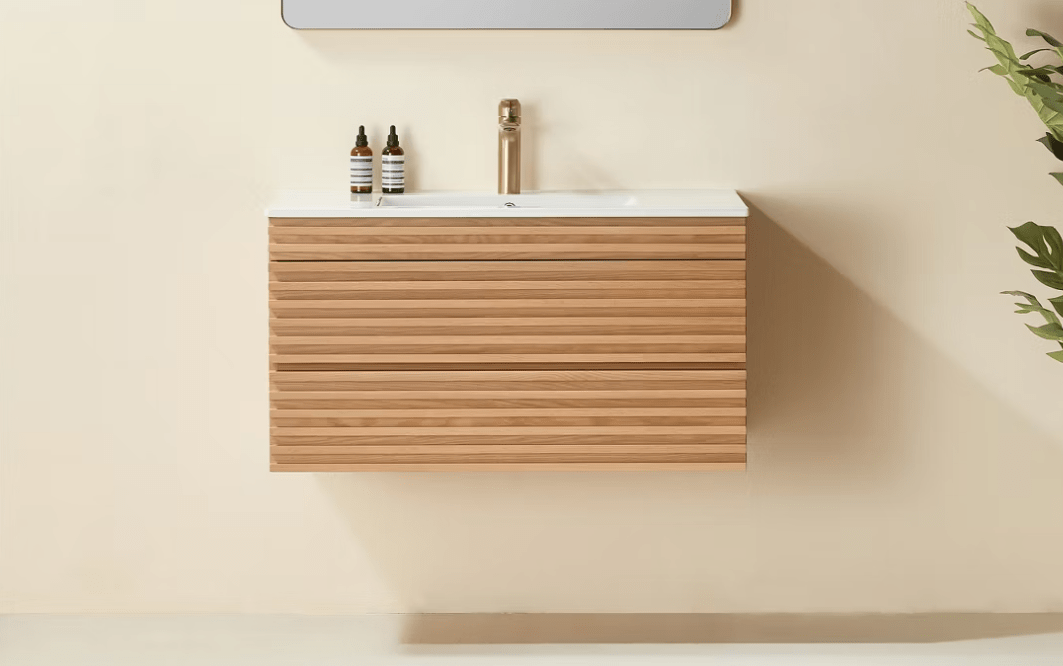
The cabinet floats eight inches above the floor on a steel cleat rated to 350 pounds. Hidden channels keep the upper drawer clear even with offset plumbing, so measure your rough-in before ordering.
Ideal for tight baths that need storage without visual bulk.
The Lucent Bath “Aero” 36-inch floating vanity is priced at $1,750 and mounts using a 32-inch steel French cleat load-tested to 350 pounds. It features 110-lb-rated full-extension soft-close Dynapro slides and a ½-inch birch plywood box with a rift-cut white-oak slab front. The conversion-varnish finish passed the KCMA chemical-resistance panel test (CV-24-118) for durability. Looks lighter. Floating eight inches above the tile and a continuous oak slab keep lines clean.
- Hardware that lasts. Dynapro slides remained smooth after our 25,000-cycle drawer test with a 25-pound load.
- Plumbing solved. A double-walled back hides the trap, so both drawers retain full depth; confirm your rough-in sits three inches right of center.
- Installer-friendly. The steel cleat arrives pre-drilled at 16-inch centers; hit two studs, set the cabinet, and it sits level.
Ideal for five-foot-wide guest baths or any remodel that needs storage without visual bulk.
Hearth & Home “Strata” Vanity: Best Statement Texture
Solid oak flutes glued to a plywood core keep every groove sharp after humidity swings. At 21 inches deep, the cabinet leaves a comfortable 24-inch walkway in a five-foot-wide bathroom.
Ideal for remodelers who want a focal point without sacrificing floor space.
The Hearth & Home “Strata” 36-inch fluted vanity sells for around $1,450 at Wayfair and features a ½-inch birch-ply cabinet with solid white-oak fluted staves. It’s finished in a low-sheen clear lacquer that passed 24-hour coffee, vinegar, and 120-degree steam testing without blistering. The vanity measures 21 inches deep and 34 inches high with the top and uses soft-close, full-extension slides rated to 90 pounds. A three-year parts and finish warranty rounds out the specs.
Why it stands out
- Texture that stays crisp. Separate oak staves, not routed MDF. Keep each flute sharp after humidity spikes.
- Slim but storage smart. The 21-inch depth protects walkway space yet hides two shelves and a full-width drawer.
- Finish you can trust. Factory lacquer survived 24-hour chemical and steam tests with zero whitening.
- Design flexibility. Pair with bright white quartz and slim sconces; from three steps back, the flutes read as gentle shadow, not busy décor.
Also Read: 6 Common Types of Bathroom Layouts to Consider for Your New Home
Frequently Asked Questions – 36-inch Solid-Wood Vanity
01. Is a solid-wood vanity worth it in a humid bathroom?
Yes-when it pairs kiln-dried hardwood with a plywood box and a factory-applied, bathroom-rated finish. KCMA’s humidity test holds cabinets at 120 degrees Fahrenheit and 70 percent relative humidity for 24 hours; plywood boxes that pass show no warping, while particleboard often swells and delaminates.
02. What is the most durable finish for a bathroom vanity?
Post-catalyzed conversion varnish or two-component polyurethane. Both cure to 40–60 percent solids, roughly triple the 12–18 percent solids in nitrocellulose lacquer, so they resist water rings, household acids, and alcohol for 24 hours without blistering. Look for brands that publish KCMA A161.1 chemical-resistance results.
03. What depth should a 36-inch vanity be?
Most stock cabinets land between 21 and 22 inches deep, which Houzz lists as the standard depth for single-sink vanities. In baths narrower than five feet, a 19-inch shallow model leaves a safer 24-inch walkway in front of the counter. Always measure the swing of doors and drawers before you buy.
04. Floating versus freestanding-what installs faster?
Freestanding. It stands on its own base, hides uneven floors, and bolts to studs with basic brackets. A floating vanity requires solid blocking or a three-quarter-inch plywood backer between studs and must sit perfectly level-extra steps that add an hour or two for pros and even more for DIYers.
Author & Expert Review
Written By:  Gaurav Mishra | Civil Engineer & Content Writer

| Credentials: B.E. (Mahavir Swami College, Surat), Registered with Bhagwan Mahavir University (BMU). Experience: Civil Engineer with 5+ years of content writing experience, currently writing impactful articles for Gharpedia, part of SDCPL. Expertise: Specializes in writing well-researched content on residential construction, construction materials, design planning, on-site practices, and safety, blending technical accuracy with everyday clarity. Find him on: LinkedIn |
Verified By Expert: Farhan Shaikh – Senior Manager – Architect, SDCPL | Associate Member – IIA

This article has been reviewed for architectural and interior design accuracy by Farhan Shaikh, Senior Manager – Architect at Sthapati Designers & Consultants Pvt. Ltd. As the lead for all architectural and interior projects at SDCPL and an Associate Member of the Indian Institute of Architects (IIA), he brings hands-on experience in architectural planning, interior design, project coordination, and sustainable strategies. His review ensures the content reflects practical design considerations, industry best practices, and real-world applicability across both architecture and interior spaces.
Find him on : Linkedin