Table of Contents
Quick Summary
- ROI Impact: Exterior upgrades in the luxury sector now average a 95-105% return on investment at resale, provided the design aligns with market trends.
- Risk Mitigation: AI visualization eliminates the “expectation gap,” preventing costly construction change orders that plague 40% of high-end renovations.
- Speed to Market: Modern tools reduce the design-to-approval timeline by up to 70% compared to traditional architectural rendering firms.
- The “Flow” Standard: The leading tools of 2026 combine visualization, sourcing, and purchasing in a single unified interface.
In the high-stakes world of luxury real estate, the “three-second rule” has become the defining metric of 2026. That is the exact amount of time a prospective buyer-scrolling through global listings on a tablet in Dubai or New York-takes to decide if a property is worth investigating or if it should be swiped away. In this hyper-visual market, curb appeal is no longer just about aesthetics; it is about liquidity.
For property developers, architects, and homeowners, the margin for error has vanished. The old method of “imagining potential” is obsolete. Today, the ability to visualize complex renovations with photorealistic precision before breaking ground is the standard. This is where Paintit.ai, a professional platform for exterior home design, transforms from a creative novelty into a critical asset for reducing risk and accelerating value growth.
Gone are the days of waiting weeks for static CAD renders. The 2026 landscape is dominated by Generative AI platforms that offer instantaneous, high-fidelity visualization, allowing stakeholders to align on a vision, secure funding, and execute renovations with mathematical precision.
The Economics of Aesthetics: ROI in the Algorithmic Age
Why has high-fidelity visualization become a non-negotiable line item in property development budgets? The answer lies in the “Imagination Gap.”
According to 2025 data from the National Association of Realtors (NAR), nearly 85% of prospective buyers-even in the ultra-luxury bracket-cannot visualize how a property could look. They see dated brick; they cannot imagine whitewashed lime plaster. They see an overgrown lawn; they cannot envision a biophilic sculpture garden. When a seller relies on the buyer’s imagination, they are essentially discounting the property’s value.
The Cost of Uncertainty
In the luxury sector, uncertainty is the enemy of the closing price. A property listed at $5 million that requires “vision” will often sit on the market 3x longer than a turnkey equivalent. By utilizing advanced exterior design AI, sellers can present a “Virtual Renovation” that is indistinguishable from reality.
This is not merely about making a pretty picture. It is about financial modeling.
- Staging vs. Construction: Physical staging of an exterior (landscaping, painting) can cost upwards of $100,000 with no guarantee of return. Digital staging costs a fraction of that and allows for A/B testing different styles (e.g., Modern Minimalist vs. Mediterranean Revival) to see which resonates with the target demographic.
- Appraisal Leverage: Developers are increasingly using AI-generated “future state” visuals to justify higher pre-construction appraisals and secure better financing terms.
In 2026, the exterior design tool is effectively an investment instrument. It bridges the gap between current condition and future equity.
From “CAD” to “Conversation”: The Evolution of Design Tools
To understand the leap we have made, we must look at the toolset. Just five years ago, architectural visualization was a bottleneck. It involved expensive software (AutoCAD, Revit), powerful hardware, and specialized artists charging $500-$1,000 per static image. Feedback loops took days.
The Generative Shift
The paradigm shift to Generative AI has democratized high-end design, but not all AI is created equal. Early iterations (circa 2023-2024) were prone to hallucinations-adding windows where structural walls existed or inventing physics-defying roofs.
The 2026 standard, exemplified by platforms like Paintit.ai, is built on a different philosophy: EIS (Empathy, Intuitiveness, Seamlessness).
- Empathy in Design: The AI now understands cultural and architectural context. If you prompt for a “Kyoto-inspired entryway,” the model understands the specific timber tones, the interplay of shadows, and the necessity of balance, rather than just placing a generic pagoda.
- Intuitiveness: The interface has moved away from complex sliders to natural language. The barrier to entry has lowered, allowing a homeowner to collaborate with an architect in real-time.
- Seamlessness: This is the most critical evolution. The tool is no longer just a “drawer”; it is a “connector.”
The “Type, See, Tweak” Ecosystem
Modern platforms have solved the fragmentation issue. Previously, a designer would find inspiration on Pinterest, model it in SketchUp, render it in Lumion, and then search for materials in a catalog. This disjointed process killed creativity.
Today’s AI ecosystems offer a unified flow. You upload a photo of the existing estate, type your vision (“Replace siding with charred cedar, add warm perimeter lighting”), and see the result instantly. This immediacy allows for “Flow State” design-where ideas can be iterated upon without technical friction.
Strategic Facade Transformations: A Masterclass
How does one actually use these tools to drive value? It goes beyond simply changing paint colors. In the luxury market, the nuance is everything. Here is a deep dive into three critical areas where AI visualization dictates success.
1. Materiality and Texture High-Fidelity
In high-end real estate, the difference between “premium” and “standard” is often textual. It’s the difference between vinyl siding and Shou Sugi Ban (charred timber). AI visualizers in 2026 have achieved a level of photorealism where you can virtually “feel” the grain of the wood or the roughness of the stone.
- The Strategy: Use the tool to audit mixed-material facades. Current trends favor the juxtaposition of raw, organic materials (stone, wood) with sleek, industrial elements (glass, black steel).
- Risk Mitigation: Replacing a facade with natural stone is a six-figure commitment. AI allows you to verify if that specific shade of limestone clashes with the roof tiles before a single stone is ordered.
2. Lighting as Architecture
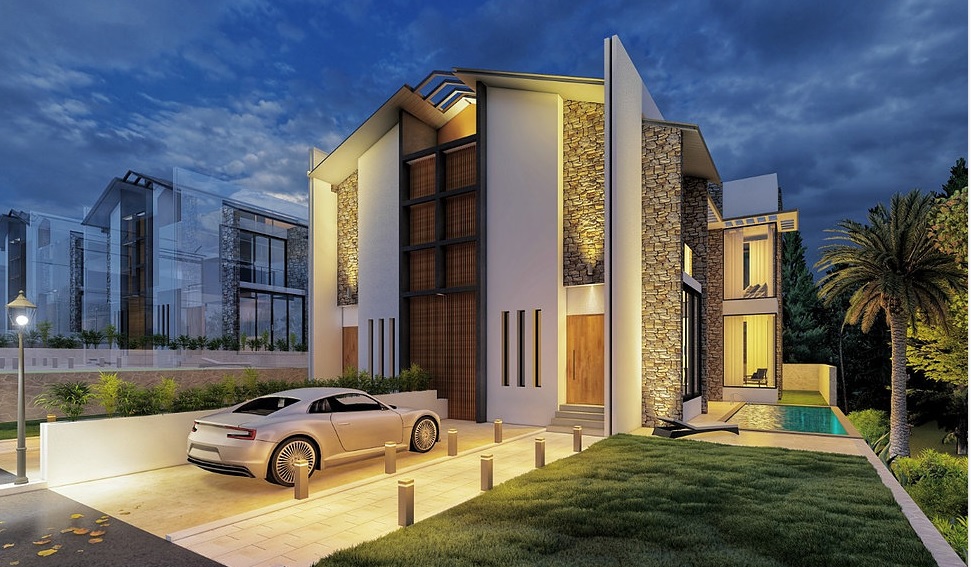
Architects have long known that light is a material, but clients often struggle to understand it until the lights are installed. Advanced exterior tools now allow for “Time of Day” simulations. You can visualize the estate at “Blue Hour” (dusk), seeing exactly how the uplighting on the architectural columns will cast shadows.
- The Value Add: A listing image showing a home glowing warmly at twilight triggers a primal psychological response of “safety” and “home,” significantly increasing click-through rates on listing platforms.
3. Biophilic Integration and Landscaping
Luxury in 2026 is defined by its connection to nature. It is not just about the house; it is about how the house sits in the land. Generative AI excels here. It can seamlessly blend a brutalist concrete structure with softening, wild landscaping.
- The Workflow: Instead of hiring a landscape architect for a preliminary sketch, you can use the AI to populate the scene with specific climate-appropriate flora (e.g., drought-resistant ornamental grasses for a Californian property). This helps in selling a “lifestyle” rather than just a plot of land.
Overcoming “Decision Fatigue” with Unified Workflows
One of the hidden costs of luxury renovations is “decision fatigue.” A homeowner or developer creates a bottleneck because they cannot decide between three shades of slate grey. This indecision halts construction crews and burns capital.
The unified workflow of modern AI tools acts as a cure for this paralysis.
- Rapid Prototyping: Within 10 minutes, a user can generate 20 variations of a facade.
- The “Elimination” Process: It is often easier for a client to say what they hate than what they love. By showing extreme options (e.g., “All Black” vs. “All White”), you can quickly narrow down the aesthetic direction.
- The Shopping Bridge: This is the frontier of 2026. Tools like Paintit.ai don’t just show you a generic “modern outdoor sofa.” They are integrated with inventory data. When you place a piece of furniture or a specific light fixture in the visualization, the system recognizes it as a purchasable SKU. This Type → See → Buy flow closes the loop between dreaming and acquiring.
This seamlessness reduces the “friction cost” of design. When a client sees the result and knows exactly what to buy to achieve it, the checkbooks open faster.
2026-2027 Design Codes: What Investors Are Looking For
To maximize estate value using these tools, one must apply the prevailing design codes of the era. The AI is the brush, but the investor is the artist. What themes are dominating the top 1% of the market?
The Rise of “Quiet Luxury” Exteriors
Ostentatious displays of wealth are out. The 2026 aesthetic is defined by “Quiet Luxury”-clean lines, monochromatic palettes, and an emphasis on privacy.
- Visualizing it: Use the AI to strip away ornate columns or decorative trim. Replace them with clean, flat planes and hidden lighting. The goal is a facade that whispers rather than shouts.
Climate-Resilient Aesthetics
With changing weather patterns, luxury buyers are looking for homes that look (and are) fortified.
- Visualizing it: Use the tool to experiment with metal roofing (fire resistance) or xeriscaping (drought tolerance). Showing a buyer that a home is both beautiful and resilient is a powerful sales tactic.
The Indoor-Outdoor Blur
The barrier between the living room and the patio is dissolving.
- Visualizing it: Use the tool to match the exterior paving stones with the interior flooring. Create a visual continuity that makes the square footage feel infinite. This psychological trick effectively “doubles” the perceived living space in listing photos.
Summary & Verdict
We have entered an era where the digital twin of a home is as valuable as the bricks and mortar themselves. The ability to manipulate, refine, and perfect that digital twin before committing capital is the ultimate form of leverage in the real estate market.
An exterior house design tool is no longer a sandbox for daydreams; it is a feasibility engine. It protects investors from bad decisions, accelerates the sales cycle for brokers, and gives homeowners the confidence to execute bold visions.
In a market that demands perfection, those who build “blind” are gambling. Those who visualize with high-fidelity AI are investing. As we move deeper into 2026, the question is not whether you can afford to use these tools, but whether you can afford not to. The technology is ready. The flow is seamless. The only limit remaining is the scope of your own vision.
Also Read: How Interior Design is Transforming Real Estate Value in 2025
FAQs
1. How does AI exterior design actually increase a property’s resale value?
AI exterior design increases resale value by removing uncertainty from the buying decision. High-fidelity visualisations allow buyers to see the future state of the property immediately, rather than relying on imagination. This improves click-through rates, shortens time on market, and supports stronger asking prices. In the luxury segment, where perception drives liquidity, clarity directly translates into value.
2. Is AI exterior staging only useful for new builds, or also for renovations?
It is arguably more valuable for renovations. AI staging allows developers and homeowners to test material choices, lighting schemes, and landscaping concepts before committing capital. This prevents costly mid-build changes and enables confident decision-making, particularly on high-risk items such as stone façades, timber cladding, or structural lighting.
3. How accurate are AI-generated exterior designs compared to traditional renders?
By 2026 standards, leading platforms produce photorealistic results that are accurate enough for investment modelling, planning discussions, and marketing. Unlike older generative tools, modern systems respect structural constraints, material behaviour, and environmental context. While they do not replace architectural drawings for construction, they dramatically outperform static renders for speed, iteration, and strategic alignment.
Author & Expert Review
Written By:  Gaurav Mishra | Civil Engineer & Content Writer
| Credentials: B.E. (Mahavir Swami College, Surat), Registered with Bhagwan Mahavir University (BMU). Experience: Civil Engineer with 5+ years of content writing experience, currently writing impactful articles for Gharpedia, part of SDCPL. Expertise: Specializes in writing well-researched content on residential construction, construction materials, design planning, on-site practices, and safety, blending technical accuracy with everyday clarity. Find him on: LinkedIn |
Verified By Expert:  Ravin Desai – Co Founder – Gharpedia | Co Founder – 1 MNT | Director – SDCPL
This article has been reviewed for technical accuracy by Ravin Desai, Co-Founder of Gharpedia and Director at Sthapati Designers & Consultants Pvt. Ltd. With a B.Tech. in Civil Engineering from VNIT Nagpur and an M.S. in Civil Engineering from Clemson University, USA, and over a decade of international and Indian experience in the construction and design consultancy sector, he ensures all technical content aligns with industry standards and best practices.
Find him on: LinkedIn