Table of Contents
Quick Summary
- This article explains how hailstorms quietly reduce the lifespan of asphalt shingle roofs.
- It describes how hail impacts shingles by removing protective granules and damaging the internal mat.
- The guide explains why hail damage is often invisible at first but accelerates roof ageing over time.
- It highlights the risks of repeated hailstorms and how cumulative damage weakens roofing systems.
- Readers learn how granule loss increases UV exposure and causes brittle shingles.
- The article also covers bruising, fractures, flashing damage, and wind vulnerability.
- It stresses the importance of post storm inspections and documentation to prevent costly surprises.
A roof can appear in good condition from the outside, yet be nearing the end of its life. In Oklahoma City, the costliest error is treating a hailstorm as a one-time event rather than a cyclical stress test. Asphalt roofs do not typically fail catastrophically after a storm. They shed small bits of their protective layer, then leak months later as the effects of heat, wind, and water complete the damage.
Oklahoma City is in an area where hailstorms can be common and unpredictable, which means that property managers and owners often face the effects of cumulative damage rather than a direct hit. The question is no longer whether a hail storm makes its presence known. The question is how that presence affects a roof’s lifespan in ways that can easily go unnoticed until it is almost too late.
Why Hail Damage is Not Always Obvious
01. Why Does Lifespan Loss Accelerate After Storms
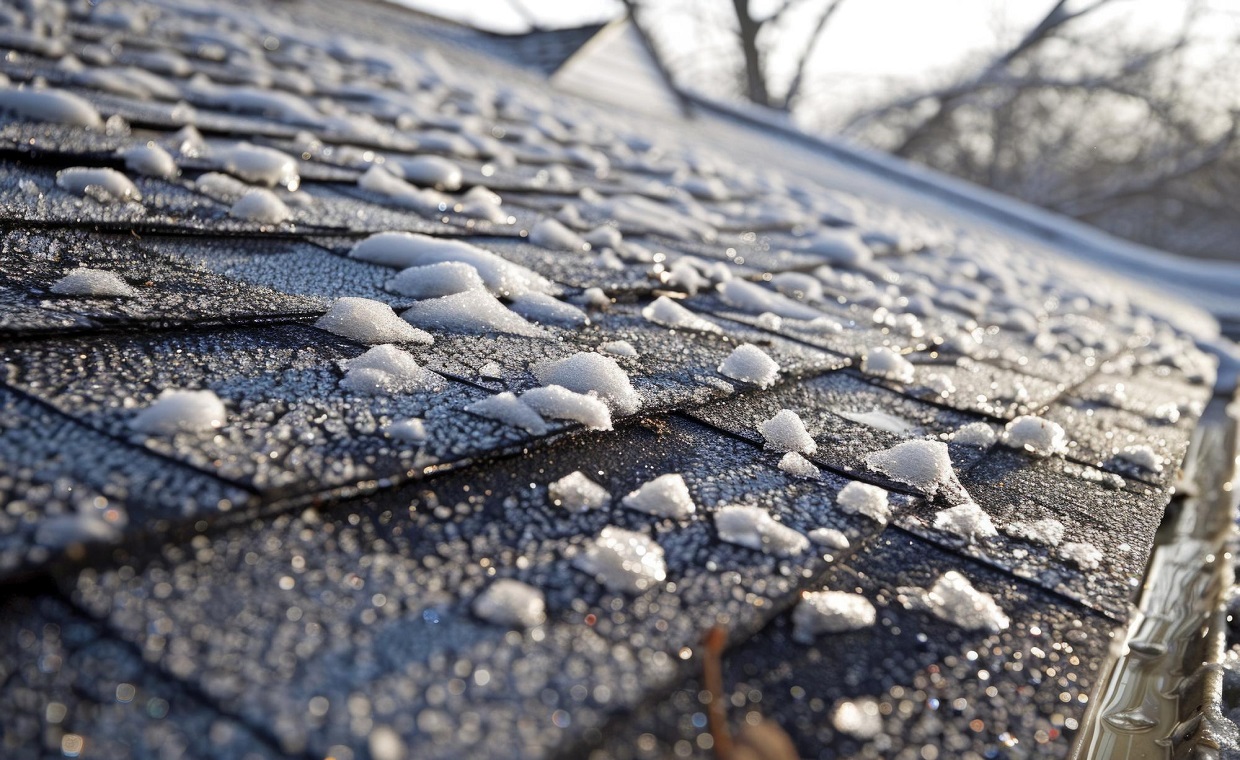
The initial life-shortening impact of hail on asphalt shingles is not immediately visible. Most homeowners will be searching for missing tabs or visible damage, but hail will initially damage the shingle mat, displacing the granules that protect the asphalt from the sun. These granules are not merely aesthetic. They are the protective armor that blocks UV rays, regulates temperature, and slows oxidation. Without them, the shingle will dry out and become brittle more quickly, and begin to crack from normal expansion and contraction.
This explains why two roofs of the same age can rapidly diverge after a hailstorm. One roof has retained most of its granule protection and is still aging predictably. The other roof has lost its protection in scattered areas that rapidly become heat-stressed hotspots. The roof may still be functioning properly today, but it is now aging at an accelerated rate, and the difference between appearance and performance grows with each passing day.
02. What Hail Actually Does to Shingle Layers
Asphalt shingles are layered materials, not single tiles. The top layer of asphalt is granular. Then comes the reinforced fiberglass mat. This mat provides the shape and strength to the shingle. Hail strikes the shingle like a series of hammer blows. Even if a hailstone does not break a shingle, it can damage the asphalt and granule bond or crush the mat, creating a bruise that reduces the shingle’s strength.
Bruises are important because they alter the shingle’s performance characteristics. When wind lifts the edge of a shingle, when people walk on it, or when the sun heats it, the bruised areas will react differently from the unbruised areas. Eventually, the bruised areas will be the first to fail, the first to lose more granules, and the first to allow water into the system during wind-driven rain.
03. The Compounding Risk After Multiple Storms
A single hail event can reduce life expectancy, but repeated storms are where Oklahoma City roofs get trapped in a slow decline. Each hail season strips a bit more granule coverage and adds more micro damage. That cumulative effect is why a roof can seem fine after the latest storm but fail earlier than budgeted. The roof is not resetting between seasons; it is sustaining damage.
This is also why timing matters for inspections and documentation. Many properties are only checked when a leak occurs or tenants complain. By then, the roof has often taken several hits, and the damage pattern is more widespread, making repairs less predictable and replacements more urgent. A proactive inspection cycle after the hail season reduces surprises and helps keep replacement schedules aligned with asset planning rather than emergency response. For property teams coordinating post-storm assessments, Oklahoma City Roofing Contractor can help separate cosmetic dings from functional loss and identify which slopes are actually losing years of service life.
04. Granule Loss and UV-Driven Aging
Granules regulate the roof surface environment. When hail damages the granules, the underlying asphalt is more prone to heat and sunlight. In Oklahoma City, during the summer, this is important because heat accelerates oxidation, making shingles brittle. Brittle shingles become brittle at the tabs, edges, and fasteners. They also seal improperly, increasing the risk of wind damage.
Loss of granules also leads to uneven aging of the roof. You can get a roof where south and west-facing slopes are already aging faster due to sunlight exposure, and hail damages the granules unevenly on the same slopes. This is when you notice shingles that curl prematurely or have widespread micro-cracking that cannot be repaired. In terms of its life cycle, hail not only damages the roof; it also puts it in a more difficult operating environment for the rest of its life.
05. Bruising, Fractures, and Water Pathways
Bruising is perhaps the most commonly misunderstood hail damage. Bruising can put pressure on the mat, loosening granules without creating a visible puncture. Later, the bruised area can develop cracks from thermal expansion. As soon as the crack appears, water has a route into the shingle mass and towards the underlayment. You may not notice a leak right away because the underlayment holds it, but that doesn’t mean everything is okay. Water can still enter, particularly during wind-driven rain, and it can find its way into a fastener line, a seam, or a weak penetration.
In Oklahoma City, where the storms can bring heavy rain with strong winds, these small routes are more important than they would be in a less windy region. Rain doesn’t fall straight down during a severe storm. It is driven sideways, forced upwards under edges, and into joints. A roof that has lost surface integrity is more susceptible each time wind and rain combine.
06. Seal Strip Disruption and Wind Vulnerability
Asphalt shingles are often sealed with a seal strip to keep them attached and prevent wind lift. Hail damage can weaken this bond indirectly through changes to the shingle surface. Add heat cycles and dust, and the seal strip may become inconsistent across the roof surface. This creates a situation that is not necessarily immediate blow-offs. Rather, it is increased fluttering and micro-lifting of the roof surface during a wind event, which then pulls on the nails and creates small holes.
As soon as the roof becomes more susceptible to wind damage, hail damage can feed into wind damage and vice versa. A roof that would have withstood a windy thunderstorm may now begin to lose a few tabs. A few missing tabs mean the underlayment is exposed, and it is not intended to be a long-term weather surface. This is how a roof goes from stable to unstable without a single dramatic event.
07. Flashings, Vents, and Soft Metal Damage
Hail damage is not limited to roofing shingles. Hail can damage soft-metal flashings, buckle ridge vents, and accessories that keep water out of the system. Damaged flashing can compromise sealant lines and create small openings. Openings in vent covers can allow wind-driven rain to enter. Even if the roofing shingles are in good condition, these supporting roof components can still cause leaks.
Facilities managers are often first alerted to a roof problem at the point of the first leak, which is typically around roof penetrations, valleys, and step flashing. The roof surface may appear in good condition from a distance, but the components that actually handle water have been damaged.
A hail-damage inspection of the roof system should treat these roof components as critical infrastructure rather than an afterthought.
Keeping Asphalt Shingles Viable After Hail Seasons
Oklahoma City hailstorms damage asphalt shingle roofs primarily by removing granules, damaging the shingle mat, and degrading the small sealing and flashing details that resist water intrusion during wind-driven rain. The roof can appear sound even as its defenses are gradually diminished, and this is what makes hail so expensive in the long run. With diligent post-storm observation, documentation, and strategic maintenance of ventilation and accessories, the roof can be slowed and replacement scheduled. The roof does not have to fail dramatically. It simply has to be stressed and miss the signs.
Also Read: A Roof You Can Trust Begins on the Ground
FAQs – Oklahoma City Hail Roof Damage
1. How does hail damage asphalt shingles?
Hail strikes can loosen granules, bruise the shingle mat, and weaken the bonding layer. This reduces the shingle’s ability to resist weather over time.
2. Can hail damage a roof without visible signs?
Yes. Many hail impacts cause bruising or granule loss that is not immediately noticeable but still weakens the roof structure.
3. Why do asphalt roofs age faster after hailstorms?
When protective granules are removed, shingles are exposed to more heat and UV radiation, which accelerates oxidation and brittleness.
4. Should a roof be inspected after every hailstorm?
It is recommended to inspect roofs after hail season or major storms to detect hidden damage early and document changes.
5. Can repeated hailstorms cause long term roof problems?
Yes. Multiple storms create cumulative damage that gradually weakens shingles, flashings, and seal strips, leading to earlier roof failure.
Author & Expert Review
Written By:  Gaurav Mishra | Civil Engineer & Content Writer
| Credentials: B.E. (Mahavir Swami College, Surat), Registered with Bhagwan Mahavir University (BMU). Experience: Civil Engineer with 5+ years of content writing experience, currently writing impactful articles for Gharpedia, part of SDCPL. Expertise: Specializes in writing well-researched content on residential construction, construction materials, design planning, on-site practices, and safety, blending technical accuracy with everyday clarity. Find him on: LinkedIn |
Verified By Expert:  Ravin Desai – Co Founder – Gharpedia | Co Founder – 1 MNT | Director – SDCPL
This article has been reviewed for technical accuracy by Ravin Desai, Co-Founder of Gharpedia and Director at Sthapati Designers & Consultants Pvt. Ltd. With a B.Tech. in Civil Engineering from VNIT Nagpur and an M.S. in Civil Engineering from Clemson University, USA, and over a decade of international and Indian experience in the construction and design consultancy sector, he ensures all technical content aligns with industry standards and best practices.
Find him on: LinkedIn