Table of Contents
Quick Summary
Before signing any rental contract abroad, students need clarity and planning. This guide covers:
- How to set a realistic student accommodation budget
- Understanding hidden costs such as deposits and utility bills
- Comparing halls of residence, PBSA, and private rentals
- Choosing the right location based on commute and lifestyle
- Using mapping tools and local reviews for smarter decisions
- Reviewing important rental contract clauses
- Completing secure cross border payments
- Avoiding common mistakes during booking
For students about to embark on study abroad journey, apart from academic planning, there is another important task awaiting you – that is to find a warm, safe and comfortable “home”. This article provides you with a “step-by-step guide on booking process for student housing”, aiming to help you clarify your thoughts, master the key steps of booking a room, avoid common pitfalls, and ultimately successfully find your desired accommodation.
Clarify Requirements & Set Budget
Before you start browsing through the wide range of available properties, the most important step is to establish a clear budget plan and accommodation requirements for yourself.
Make A Budget Plan
The budget is the cornerstone for determining your choice of rental accommodation. The cost of living and rental prices in different cities of the countries where you plan to study may vary greatly. For instance, if you plan to go to Sydney, New South Wales, Australia, you will need to prepare a substantial budget for housing. The rental prices of Sydney student accommodation are usually much higher than those in other cities in Australia, and may even account for a large portion of your study budget. A single-room apartment located in the Sydney CBD or a convenient area usually costs AU$500/week to AU$900/week or even higher. In sharp contrast, if you choose some cities in Asia, such as Tokyo or Osaka in Japan, your budget may be much lower. The rental market in Japan has its unique customs, such as higher initial fees (key money, deposit, agency fees, etc.), but the subsequent monthly rent may be relatively stable. Therefore, understanding these regional differences can help you formulate a more reasonable rental budget and allocate your study funds, avoiding being affected by excessive rent pressure and impacting your study experience.
Know The Hidden Cost in the Budget
Apart from the fixed monthly rent, many international students often overlook some “hidden expenses” when making their budget. These costs, when accumulated, may cause your actual expenditure to exceed your expectations. Therefore, be sure to include the following items in your rental budget considerations:
- Bills: Usually in student apartments includes the utility bills and internet fees, while private rentals may exclude them.
- Deposit (Bond): Almost all rental contracts require the payment of a deposit, usually for 1 to 2 months’ rent. This money is used to protect the landlord’s rights in case of damage to the property or the tenant’s breach of contract.
- Contents Insurance: Although not mandatory, purchasing Contents Insurance can protect your personal belongings from loss in unexpected situations (such as fire, theft).
Clarify Your Personal Needs
Within the budget, you need to consider the following accommodation-related issues, which will directly affect your living experience:
- Location: Prefer to be close to the campus or value convenience (supermarkets, restaurants, gyms)? Do you mind the commuting time?
- Type of Accommodation: Prefer individual space (single apartment) or enjoy sharing with others (shared apartments)?
- Facilities: What are your requirements for facilities such as kitchens, bathrooms, laundry rooms, gyms, study areas? Do you need a furnished property with complete furniture?
- Safety & Environment: What’s your requirement on safety of living environment? Prefer a quiet study atmosphere or a lively social environment?

Understand Accommodation Types
After you have clarified your requirements and budget, the next step is to confront the various types of accommodation available in the market.
Halls of Residence
These are usually directly managed by the university or operated in collaboration with the university, located on the campus or adjacent to it. The room types vary, including single rooms, en-suites (with separate bathrooms), or non-en-suites (with shared bathrooms). They typically include catering plans (Catered) or self-catering options (Self-catered). The rent for on-campus dorms is usually quite high, but with all-inclusive bills. There are 24-hour security and dormitory management staff, ensuring a high level of security. However, the number of dormitory spots is limited, so applications should be made as early as possible.
Purpose-Built Student Accommodation (PBSA)
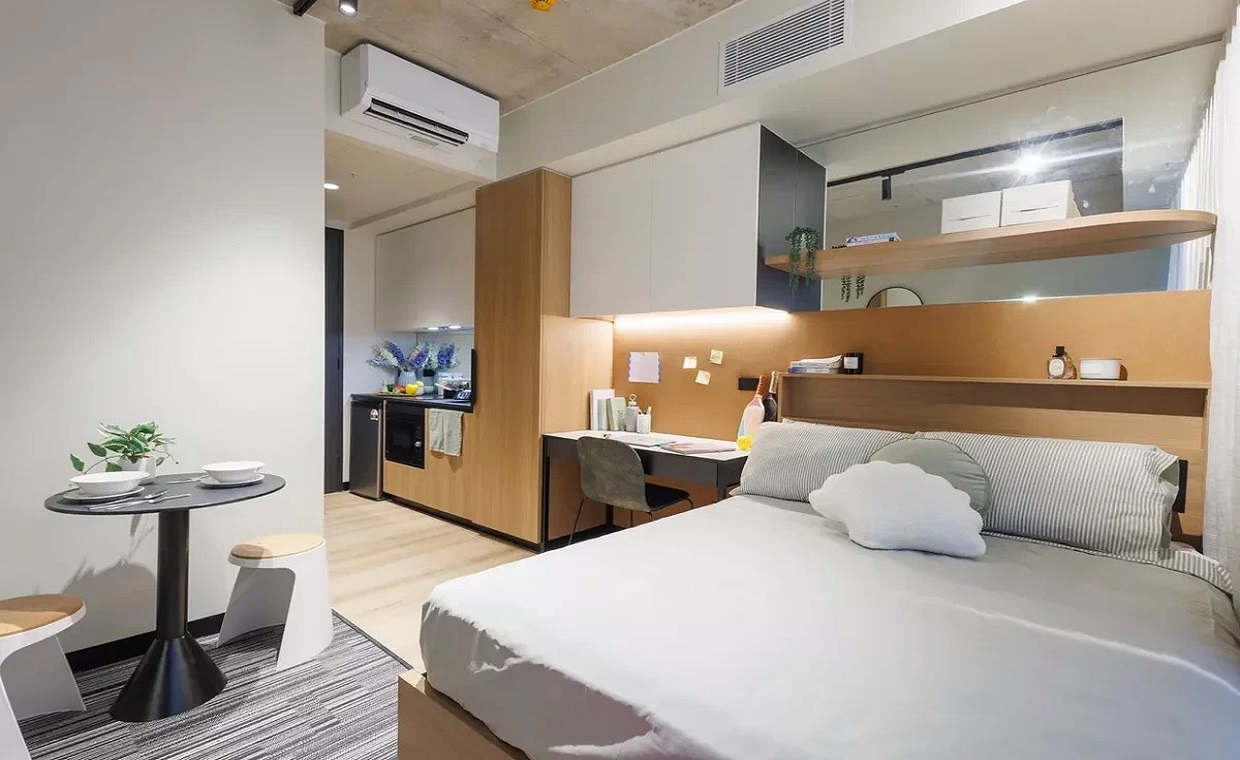
Developed and operated by a professional student accommodation company, it is specifically designed and constructed for students. Usually, PBSA provides modern facilities such as separate bathrooms, communal kitchens, gyms, study rooms, laundry rooms, etc. The management is standardized and the service is professional. The majority of PBSA rents include all bills. Meanwhile, it is located near universities or in convenient downtown areas, making it easy for students to commute.
Private Rentals
Private rentals are the apartments, villas or standalone houses rented from private landlords. The room types are the widest, ranging from single rooms to multi-shared apartments. The lease terms are flexible and can be negotiated. The rent is relatively cheaper, especially in non-central areas or when choosing to share accommodation. However, the rent does not include the costs of water, electricity, gas and internet, and one needs to handle the activation and payment procedures themselves.
Select Sites
After determining the budget and accommodation type, the next crucial step is “site selection”.
“Close” is Not Necessarily the Sole Criterion
When many students are choosing a rental property, the primary consideration is often “proximity to the campus”. However, “close” is not the only criterion, nor is it always the best one. Sometimes, in pursuit of the ultimate “proximity”, you might have to pay a higher rent or sacrifice other important aspects of living convenience.
For instance, some universities might be located in the city centre, with complete surrounding living facilities, but the rent is high and the environment might be rather noisy. While other universities might be situated at the outskirts of the city, with relatively cheaper rents but fewer living facilities and inconvenient transportation. Therefore, when weighing the distance, you need to consider it in conjunction with factors such as rent, living convenience, and community environment. For example, most of the prestigious universities in Adelaide are located in or near the CBD. Moreover, with the convenience of local public transportation and the preferential policies of student cards, as long as you live near the station, you can commute quickly and conveniently even if you rent a house in the suburbs. So, if you are looking for student accommodation Adelaide and expect a lower rent, you can definitely give up the CBD and choose a slightly farther suburb. Therefore, when choosing a residence, you can set a range of acceptable commuting times, such as within 20-30 minutes by public transportation. Within this range, you can have a wider range of housing options and more easily find a more cost-effective accommodation.
Skilfully Utilize Mapping Tools & Local Community Evaluations
- Google Maps: You can search for your university on the map and view the available housing in the surrounding area. Utilize the Street View feature to observe the surrounding buildings, shops, parks, etc. You can also find commuting routes and view the bus schedules and travel times.
- Public Transport Website/APP: Visit the official website of the public transportation operator in your study abroad city or download their APP to get detailed route maps, timetables, and ticket prices.
- Community Evaluation Websites/Forums: On Reddit, Facebook groups, or local study abroad forums, you can find real experiences from local residents and international students about the area, such as safety, noise, living convenience, and neighborhood relations, etc.
- University Official Information: Many universities’ international student offices or accommodation services departments will provide advice, recommended areas, and safety guidelines for off-campus rentals on their official websites. These are official and reliable information.
Find The Right Rental Housing Tools
During the long journey of renting a house abroad, a reliable and efficient tool can often make your task much easier and more effective. uhomes.com is a professional student accommodation booking platform that is highly praised by international students worldwide. It has a Trustpilot rating of 4.9/5 (nearly 2,000 comments). It not only helps you efficiently filter the housing options, but also provides you with comprehensive guarantees, making your overseas rental journey more peaceful. uhomes.com, with over 10 years of experience and a recommendation rate of over 99% among international students, is a truly platform that understands the needs of international students and is committed to solving their pain points. The emergence of the platform has greatly simplified the complexity of cross-border renting, improved the transparency and security of reservations, and also conveys the message of cost-effective deals to students.
- 100% Verified Listings: It directly connects with thousands of renowned student apartment suppliers worldwide. The listings you see on the platform are all real and have undergone 100% verification.
- VR House Viewing & Real Photos: If you are unable to visit the property in person, the 360-degree VR house viewing and the consultant’s real photo videos on the platform can enable you to truly experience the lighting, size of the space, and the neighborhood environment of the property.
- Zero Agent Fee & Cheapest Price Guarantee: For most of the cooperative apartments, it does not charge students any additional fees, and guarantees that the prices are synchronized with the official website of the apartment. Sometimes, it even offers exclusive rebates and subsidies.
- Multilingual Consulting Service: When you are dealing with a contract of several dozen pages in English, the multilingual professional consultants will help you understand each clause, ensuring there are no hidden traps.
Interpretation of Key Clauses in Rental Contract
- Lease Term: You can choose either a long-term lease or a short-term lease based on your academic plan and personal preferences. Short-term leases offer greater flexibility, while long-term leases can lock in prices and avoid frequent moves.
- Cancellation Policy: Can the reservation be cancelled? What fees will be incurred if the reservation is cancelled? Can the deposit be refunded? All these need to be clearly stated in the contract.
- Maintenance Responsibilities: Clearly define which maintenance costs are borne by the landlord and which are borne by the tenant.
Complete Payment Process
After you decide to book a certain property, you usually need to pay a deposit or a portion of the rent as a guarantee. Due to the cross-border payment involved, choosing a safe and reliable payment channel is crucial to avoid financial losses or information leakage. Bank wire transfer, credit/debit card, third-party payment platforms (such as PayPal, Alipay International), and the payment guarantee of uhomes.com are all commonly used payment methods by students. No matter which payment method you choose, make sure the recipient’s information is consistent with the landlord or apartment manager on the contract. Keep all payment vouchers and transaction records for future reference. If you have any questions about the payment process, please contact the platform customer service or your bank promptly.
Conclusion
With this detailed “A Step-by-Step Booking Process for Student Housing”, I believe you have gained a comprehensive and in-depth understanding of the entire process of renting an apartment abroad, the precautions to take, and how to choose the appropriate rental platform. Renting an apartment is not merely about finding a place to shelter from the elements; it is also your first lesson in embarking on independent living, adapting to a new environment, and integrating into a new culture. A successful rental experience will lay a solid foundation for your future studies and life, allowing you to focus undividedly on the ocean of knowledge, make friends from all over the world, and experience unprecedented excitement.
Also Read: Essential Steps for the People Who Buy Home for First-Time
FAQs – Student Housing Booking Process
1. When should I start the student housing booking process?
It is best to start at least three to six months before your course begins, especially in high demand cities.
2. What is included in most student accommodation rent?
Purpose built student accommodation often includes bills and internet, while private rentals usually do not.
3. How much deposit is required for student housing?
Most landlords require one to two months of rent as a deposit, depending on the country.
4. Can I cancel my booking after paying the deposit?
This depends on the cancellation policy stated in the rental contract, so always check carefully before signing.
5. Is it safe to book student accommodation online?
Yes, but only if you use verified platforms, confirm landlord details, and keep all payment records.
Author & Expert Review
Written By:  Gaurav Mishra | Civil Engineer & Content Writer
| Credentials: B.E. (Mahavir Swami College, Surat), Registered with Bhagwan Mahavir University (BMU). Experience: Civil Engineer with 5+ years of content writing experience, currently writing impactful articles for Gharpedia, part of SDCPL. Expertise: Specializes in writing well-researched content on residential construction, construction materials, design planning, on-site practices, and safety, blending technical accuracy with everyday clarity. Find him on: LinkedIn |
Verified By Expert:  Shekhar J. Parikh Co Founder – Gharpedia | Director – SDCPL
This article has been reviewed for technical and execution accuracy by Shekhar J. Parikh, Director and Consulting Engineer at Sthapati Designers & Consultants Pvt. Ltd. With over 40 years of experience in civil engineering, project execution, and construction management across Gujarat and Maharashtra, he ensures the content reflects practical site knowledge, quality control standards, and industry best practices, while also supporting informed decision-making for property buy, sell, and rent considerations.
Find him on : Linkdin