







Table of Contents
Quick Summary
- Cement is the backbone of modern construction, and its quality depends on the raw materials used in manufacturing.
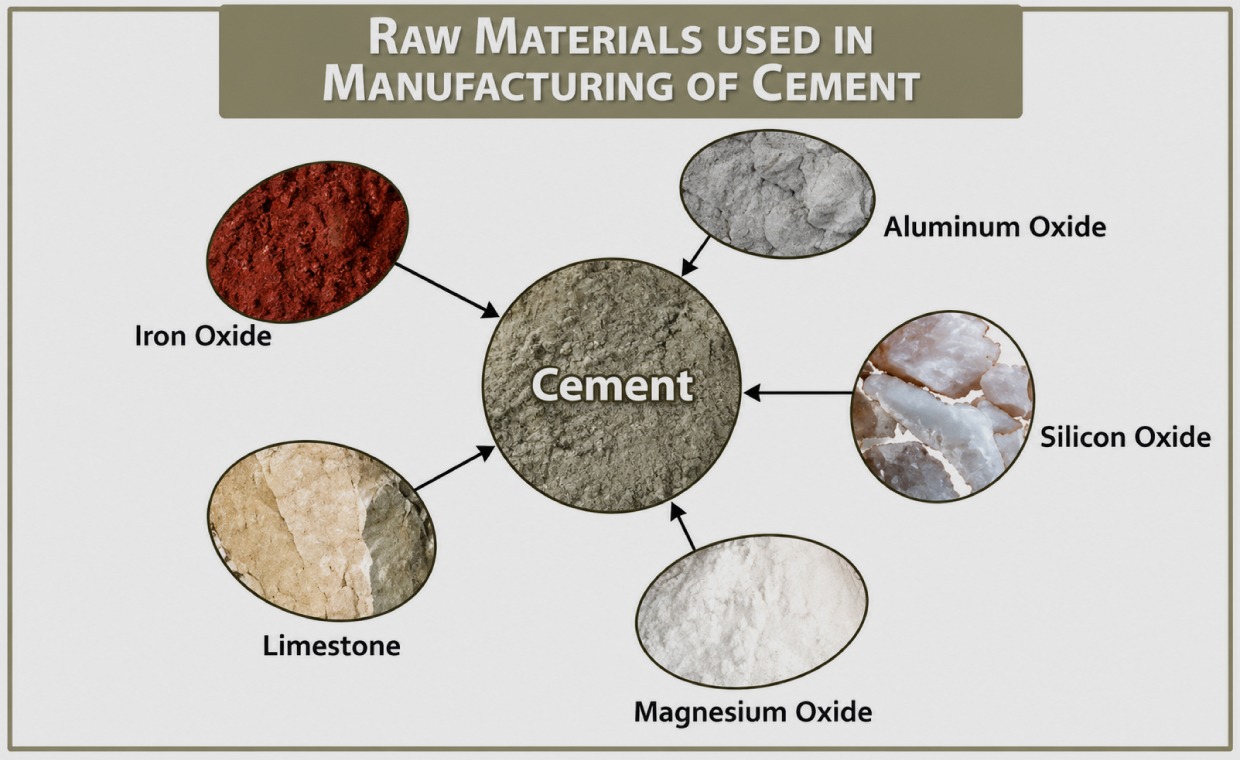
- The main raw materials of cement include limestone, clay, shale, iron ore, and gypsum, each contributing specific properties.
- Limestone provides calcium oxide for strength and binding, while clay and shale supply silica, alumina, and iron oxide.
- Gypsum controls the setting time of cement and improves workability.
- The manufacturing process involves crushing, mixing, kiln heating, clinker cooling, and grinding.
- Chemical constituents like lime, silica, alumina, and iron oxide directly affect cement strength, durability, and performance.
- Supplementary materials such as fly ash and GGBS improve sustainability and durability in blended cement.
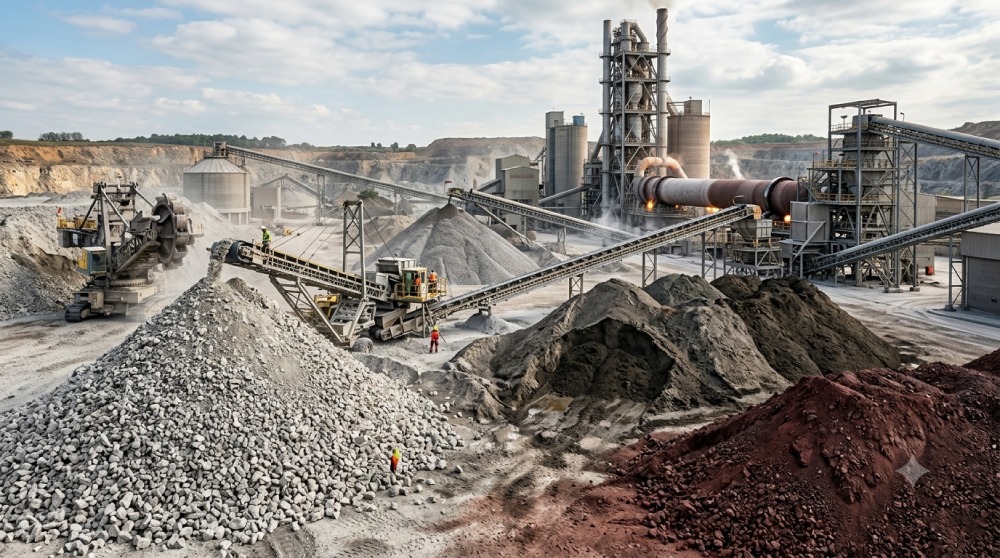
Think of buildings, and you will instantly think of one material: cement, which is rightly called the backbone of modern construction. Yes, cement holds together almost every structure around us. But have you ever wondered what gives cement its strength, durability and binding power?
The secret lies in the ingredients or the raw materials that go into making cement.
From natural limestones to industrial by-products like fly ash, each element plays a role in determining how cement performs. Want to know more about raw materials used for manufacturing cement?
This article breaks down the raw materials used in manufacturing Portland cement, their functions, and how they influence the final product.
What Are the Raw Materials of Cement?
Raw materials used in the manufacture of Portland cement are naturally present in the Earth’s crust. It is made primarily from calcareous (rich in calcium carbonate) and argillaceous (rich in silica, alumina, and iron oxide) materials, along with gypsum.
Calcareous materials include limestone or chalk, whereas argillaceous materials are generally found in the form of clay or shale. These ingredients are carefully proportioned and processed to produce cement with the desired strength, setting time, and durability. Let’s understand the various types of cement raw materials used in the cement manufacturing process.
Main Raw Materials Used in Cement Manufacturing
01. Limestone
Limestone is the most important raw material in cement manufacturing. It provides calcium oxide (CaO), which is responsible for the binding properties and strength of cement. Since limestone forms the largest portion of cement composition, the quality of limestone significantly affects the final quality of cement. High-purity limestone helps in producing stronger and more durable cement.
02. Clay
Clay supplies important constituents like silica (SiO₂), alumina (Al₂O₃), and iron oxide (Fe₂O₃). These components form cement compounds like tricalcium silicate (C₃S), and dicalcium silicate (C₂S), which are largely responsible for the hardening and strength development of cement.
03. Shale
Shale is an alternative to clay. It is a fine-grained sedimentary rock rich in silica and alumina. It is used when clay of suitable quality is not readily available. Shale helps maintain the chemical balance required during cement production.
04. Iron Ore
Iron ore assists in the fusion of raw materials during clinker formation and contributes to the colour and hardness of cement. It is added in small quantities with other raw materials.
05. Gypsum
Gypsum regulates the initial setting time and thus improves the workability of cement. It is added at the grinding stage of clinkers. Without gypsum, cement tends to set fast after mixing with water, making it difficult to handle and place properly.
How Raw Materials Are Converted into Cement
Many people know the ingredients of cement but are unaware of how these materials are transformed into the fine grey powder used in construction.
The manufacturing process generally involves the following stages:
- Crushing and grinding of raw materials
Limestone, clay, and other materials are crushed into fine particles. - Mixing and proportioning
Raw materials are blended in precise proportions to achieve the required chemical composition. - Heating in a rotary kiln
The mixture is heated at extremely high temperatures to form clinker. - Clinker cooling
The hot clinker is cooled rapidly to preserve its properties. - Addition of gypsum and final grinding
Gypsum is added, and the mixture is finely ground to produce cement.
This controlled process ensures consistency, strength, and durability in the final product.
Chemical Constituents of Ordinary Portland Cement (OPC)
The performance of cement largely depends on its chemical oxide composition. Each oxide contributes differently to the properties of cement.
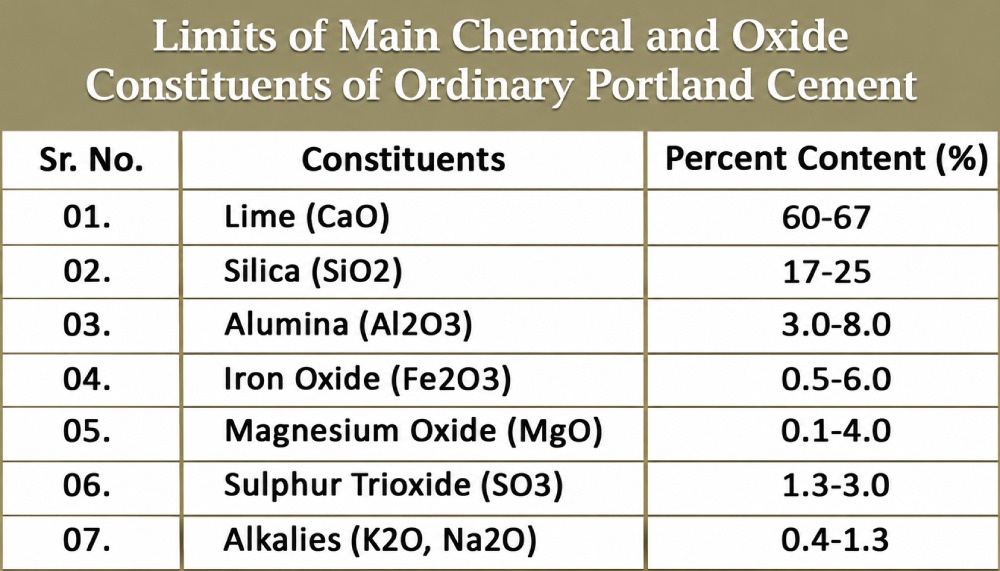
01. Lime (CaO)
Lime contributes to the binding property and strength of cement. However, it should be added in the right proportion. Excess lime may cause cement to expand and insufficient lime may reduce the strength, resulting in quick setting.
02. Silica (SiO₂)
Silica imparts strength to cement by forming C₂S and C₃S compounds. However, an excess of silica content adds to strength but considerably lowers the setting time of cement.
03. Alumina (Al₂O₃)
Alumina improves the setting properties of cement and acts as a flux during clinker formation by reducing the temperature during cement manufacturing. Excess of alumina results in reduced strength.
04. Iron Oxide (Fe₂O₃)
Iron oxide gives grey colour to the cement and improves hardness. It also aids in the fusion of raw materials during clinker production.
05. Magnesium Oxide (MgO)
Magnesia imparts strength when present in small amounts. However, an excess of it can make cement unsound and unstable.
06. Sulphur Trioxide (SO₃)
It ensures the soundness regulates the setting time of cement. Excess of sulphur trioxide causes unsoundness and delayed expansion.
Limits of Main Chemical and Oxide Constituents of OPC are Given in this Table
Blended Cement and Supplementary Materials
Blended cement is produced by mixing cement clinker with supplementary cementitious materials such as:
- Fly ash
- Ground granulated blast furnace slag (GGBS)
- Silica fume
- Natural pozzolana
These materials improve durability, workability, and sustainability while reducing the heat of hydration.
Conclusion
The raw materials used for manufacturing cement include limestone, clay, shale, iron ore, and gypsum. All these materials have different roles in cement manufacturing. Some impart strength, whereas some give a binding property. Knowing their details helps you better understand cement and its handling. The quality and proportion of these materials determine the quality, strength, and durability of cement.
Also Read: Special Cements & Their Applications
FAQs: Raw Materials of Cement
01. What is the main raw material of cement?
Lime, obtained from limestone, is the main raw material of cement. It constitutes 60-67% of cement.
02. Why is gypsum used in cement?
Gypsum is added to increase the initial setting time of cement. When water is added to cement, it tends to flash set. Gypsum slows down this setting time and makes it workable.
03. Why are supplementary materials added to cement?
Supplementary materials have cementitious properties. They are added to cement to improve durability, enhance workability, and increase sustainability.
Author & Expert Review
Written By:  Nidhi Patel | Civil Engineer & Content Writer

| Credentials: B.E. (Mahatma Gandhi Institute of Technical Education and Research Centre), Registered with Gujarat Technological University (GTU). Experience: Civil Engineer with 3+ years of content writing experience, currently writing blogs for Gharpedia, part of SDCPL. Expertise: Specializing in SEO-optimized blogs and long-form articles focused on home improvement, construction, interiors and architect topics. I create well-researched, reader-focused content that balances technical accuracy with clarity, making complex subjects easy to understand. Find her on: LinkedIn |
Verified By Expert: Avni Desai Environmental Engineer, SDCPL | M.E. (Environmental Engineering)
 Avni Desai Environmental Engineer,
This article has been reviewed for environmental, MEP, and building services accuracy by Avni Desai, an Environmental Engineer at Sthapati Designers & Consultants Pvt. Ltd. (SDCPL). With over 8 years of experience in water supply, wastewater management, infrastructure design, and building services, she brings practical expertise in MEP services, sustainable solutions, design planning, and on-site practices. Her professional services include planning and design of water supply systems, sewage and wastewater treatment systems (STP/WTP), drainage, rainwater harvesting, and other sustainable building services. Her review ensures the content aligns with environmental standards, efficient services planning, and real-world applicability.
Find her on: LinkedIn